
Brief
The car buying experience in the U.S. is broken—customers face problems with lack of transparency, complex financing processes, and pressure from traditional dealerships. Many struggle with a time-consuming purchase journey that leaves them feeling uncertain and frustrated. We wanted to launch a customer-obsessed way to buy cars on Amazon where customers could enjoy upfront pricing, seamless financing options, and a hassle-free online purchase experience.
Outcome
Amazon Autos is now available in 60+ U.S. cities, allowing customers to buy cars on Amazon for the first time with transparent pricing, seamless trade-in options, and flexible financing. The service provides a hassle-free, end-to-end car buying experience within the familiar Amazon ecosystem, with plans to expand to more brands, cities, and financing options in the future.
It is still early in the launch, so metrics are limited, but we’ve surpassed first-month sales goal by 100%, achieving 200% of target, and the NPS is 34% above target at 79.8 (a score above 50 is considered excellent).
Amazon Autos is now available in 60+ U.S. cities, allowing customers to buy cars on Amazon for the first time with transparent pricing, seamless trade-in options, and flexible financing. The service provides a hassle-free, end-to-end car buying experience within the familiar Amazon ecosystem, with plans to expand to more brands, cities, and financing options in the future.
It is still early in the launch, so metrics are limited, but we’ve surpassed first-month sales goal by 100%, achieving 200% of target, and the NPS is 34% above target at 79.8 (a score above 50 is considered excellent).
My Role
As a Lead Product Designer on this 0 → 1 project, I was responsible for the design, research, and delivery of the upper funnel experience, including saved cars (cart), checkout, and post-purchase. I also owned the end-to-end trade-in experience and led project-wide marketing efforts, supporting the design of banners, social campaigns, and Amazon-hosted marketing pages. A junior designer supported me throughout the project; I worked closely with them, reviewed their designs, and assigned them work.
In my role as Accessibility Lead, I ensured an accessible end-to-end experience by conducting accessibility office hours, reviewing designs for compliance, and leading UAT for accessibility.
Toolkit
Design: Figma · Adobe Illustrator, InDesign, and Photoshop · InVision
Research: Qualtrics · SurveyMonkey · UserTesting · Miro · Dovetail
Bringing car buying to Amazon for the first time. Reimagining the experience with transparency, simplicity, and customer obsession.
Bringing car buying to Amazon for the first time. Reimagining the experience with transparency, simplicity, and customer obsession.
Amazon Autos
Amazon Autos
AMAZON AUTOS
Bringing car buying to Amazon for the first time. Reimagining the experience with transparency, simplicity, and customer obsession.
Brief
The car buying experience in the U.S. is broken—customers face problems with lack of transparency, complex financing processes, and pressure from traditional dealerships. Many struggle with a time-consuming purchase journey that leaves them feeling uncertain and frustrated. We wanted to launch a customer-obsessed way to buy cars on Amazon where customers could enjoy upfront pricing, seamless financing options, and a hassle-free online purchase experience.
Outcome
Amazon Autos is now available in 60+ U.S. cities, allowing customers to buy cars on Amazon for the first time with transparent pricing, seamless trade-in options, and flexible financing. The service provides a hassle-free, end-to-end car buying experience within the familiar Amazon ecosystem, with plans to expand to more brands, cities, and financing options in the future.
It is still early in the launch, so metrics are limited, but we’ve surpassed first-month sales goal by 100%, achieving 200% of target, and the NPS is 34% above target at 79.8 (a score above 50 is considered excellent)
My Role
As a Lead Product Designer on this 0 → 1 project, I was responsible for the design, research, and delivery of the upper funnel experience, including saved cars (cart), checkout, and post-purchase. I also owned the end-to-end trade-in experience and led project-wide marketing efforts, supporting the design of banners, social campaigns, and Amazon-hosted marketing pages. A junior designer supported me throughout the project; I worked closely with them, reviewed their designs, and assigned them work.
In my role as Accessibility Lead, I ensured an accessible end-to-end experience by conducting accessibility office hours, reviewing designs for compliance, and leading UAT for accessibility.
Toolkit
Design: Figma · Adobe Illustrator, InDesign, and Photoshop · InVision
Research: Qualtrics · SurveyMonkey · UserTesting · Miro · Dovetail
Starting with the future
Creating an end-to-end vision for the near-term future of Amazon Autos
We successfully launched Amazon Autos to the public as a minimal lovable product (MLP), focused on core functionality. Post-launch, we're looking ahead to improve the experience based on insights gathered from the public launch, making the product more lovable and driving increased engagement.
I led a team of designers to define the future vision, addressing key pain points, including lack of pricing transparency, uncertainty about next steps after checkout, and limited pickup and delivery options.
To drive alignment, I’ve presented this vision across the org—from leadership to product and engineering stakeholders. Externally, I’ve presented it to potential partners to entice more car brands to join and created a video walkthrough, which you can watch here:
Video walkthrough of the future Amazon Autos experience.
Designing and launching MLP
Discovery – generative research
I joined this project from its inception, relocating from London to New York to support its execution within Amazon Advertising. To kick things off, I worked closely with a Senior Researcher to conduct generative studies aimed at better understanding our target customers, evaluating their current car buying experience, identifying opportunities for improvement, and recognizing what was working well.
Through our research, we uncovered the following key themes and needs:
Lack of pricing clarity and trust
Lack of pricing clarity and trust
Overwhelming and fragmented processes
Overwhelming and fragmented processes
Uncertainty around trade-in value
Uncertainty around trade-in value
Lack of control and convenience
Lack of control and convenience
Key themes uncovered in early research.
Key themes uncovered in early research.
In addition to uncovering these user challenges, we translated them into “How Might We” statements to guide ideation and solution development within the team.
To further align our solutions with customer needs, we developed three key personas—New-to-the-Scene, Up-and-Comers, and Established. These personas were shared with the team to provide insights into customer goals, behaviors, and pain points, helping us tailor our approach and prioritize features effectively.
These insights provided a clear understanding of the key pain points and opportunities within the car buying journey, fostering broad alignment across the team. With this shared understanding, we transitioned into the ideation phase to explore and develop solutions that directly address customer needs.
Established
Age Range
49
-
60
Late Generation X
Mid Boomer
Household income
$
160
-
500
k
Location
Rural
Children
Likely
(Older)
Age Range
35
-
48
Household income
$
80
-
240
k
Location
Suburban
Children
Likely
(Younger)
Up-and-Comers
Mid Millenial
Mid Generation X
New-to-the-scene
Age Range
21
-
34
Generation Z
Late Millenial
Household income
$
60
-
100
k
Location
Urban
Children
Maybe
Three personas representing Amazon Autos customers. Click on each to find out more.
Three personas representing Amazon Autos customers. Click on each to find out more.
Ideation
The first stage of the project focused on building a Minimal Lovable Product (MLP), launched as an internal beta to prove the feasibility of selling cars online. This involved integrating disparate dealer, Original Equipment Manufacturer (OEM), and financial systems into a cohesive, Amazon-hosted customer experience. My primary focus, with the support of a junior designer, during this phase was on the lower-funnel journey, specifically saved cars (cart), checkout, and post-purchase.
I designed an end-to-end checkout experience, leveraging insights from my previous work on the Amazon Barclaycard project and broader desk research. Findings indicated that a one-thing-per-page format yields higher conversion rates, fewer errors, and improved accessibility. So this approach was also taken for checkout with the aim oi simplifying the customer journey and enhancing overall usability.
To validate the experience, I conducted user research with customers and traveled to Los Angeles to facilitate workshops with both the OEM and our Digital Retailing Solution (DRS) partner—key stakeholders in facilitating online vehicle purchasing. The purpose of these exercises was to evaluate the existing experience from both a user need and technical / business feasibility perspective.
During the evaluative workshops, I provided an on-screen walkthrough of the experience, highlighting key touchpoints and functionality. In addition, I printed each screen for an interactive session where stakeholders used post-it notes to identify areas for improvement, feasibility considerations, and necessary changes. This collaborative process helped align cross-functional teams and refine the experience based on real-world constraints and opportunities.

Stakeholders collaborate using post-it notes to identify improvements, feasibility considerations, and necessary changes in this evaluative workshop.
To assess the customer experience, I created a clickable prototype in Figma and conducted a moderated usability study. I collaborated with a junior designer to assist with note-taking and synthesis. The study focused on the end-to-end checkout experience on desktop, covering the journey from Saved Cars to the Thank You page.
The following video provides a walkthrough of the prototype tested, showcasing the first iteration of the lower funnel experience I designed.

First iteration of the lower funnel experience: A walkthrough of the clickable prototype tested.
The research was vital in identifying strengths in the experience and areas for improvement. A sample of findings are summarized below:
Strengths
Familiar and seamless experience
Familiar and seamless experience
Strengths
Financial transparency
Financial transparency
Core functionality
Core functionality
Pain points
Purchase status ambiguity
Purchase status ambiguity
Pain points
Data handling concerns
Data handling concerns
Key themes uncovered in the internal beta
Findings from this research, along with insights from OEM and DRS workshops, informed improvements to the experience, ensuring customer needs were met while aligning with business and technical requirements. Similar processes were conducted by myself and a supporting junior designer for the post-purchase experiences.
A sample of the screens designed for the internal beta is shown below, from a time when the product was still referred to as Amazon Cars.
→
→
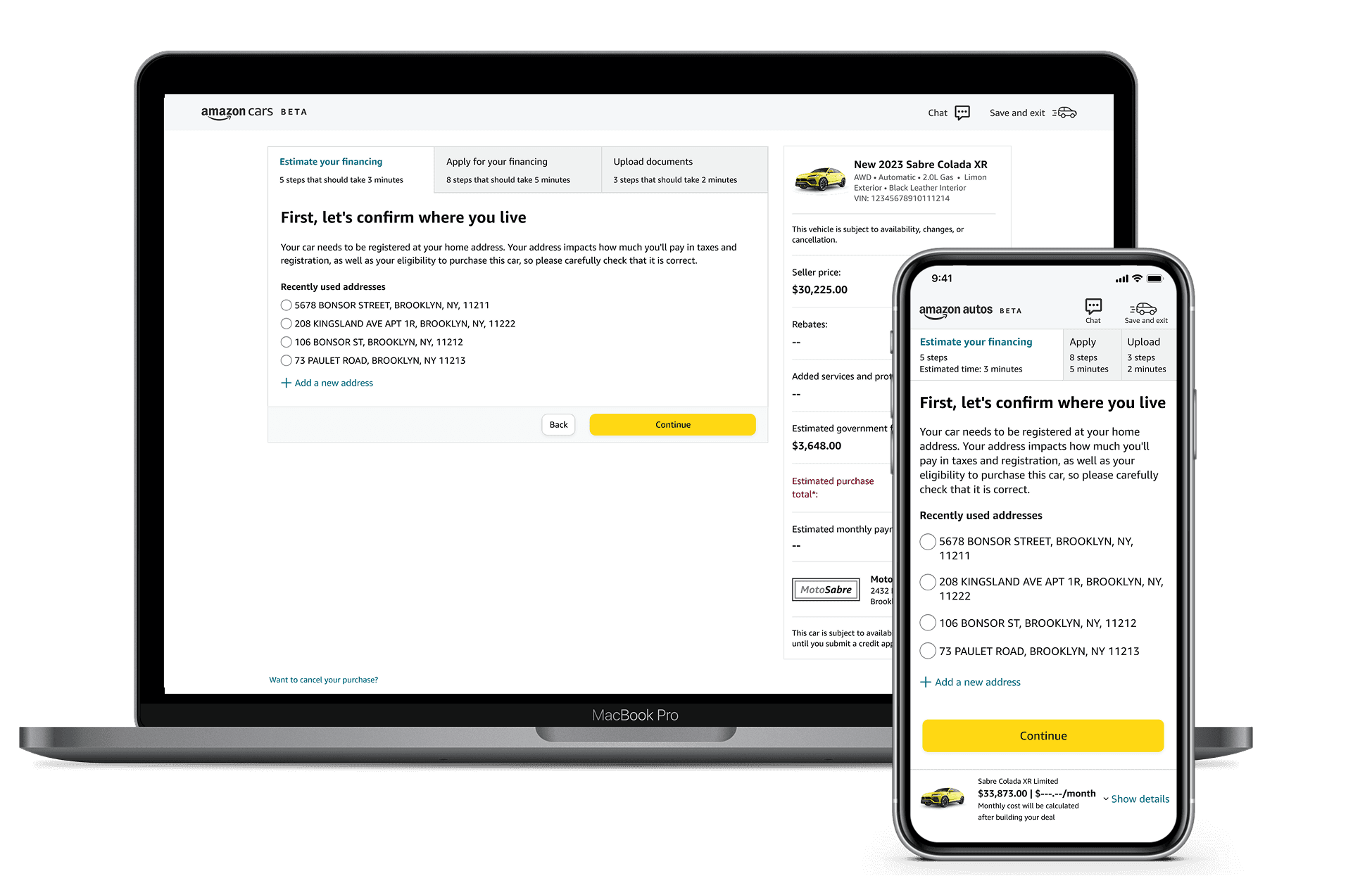
Sample of screens designed for the internal beta.
→
→
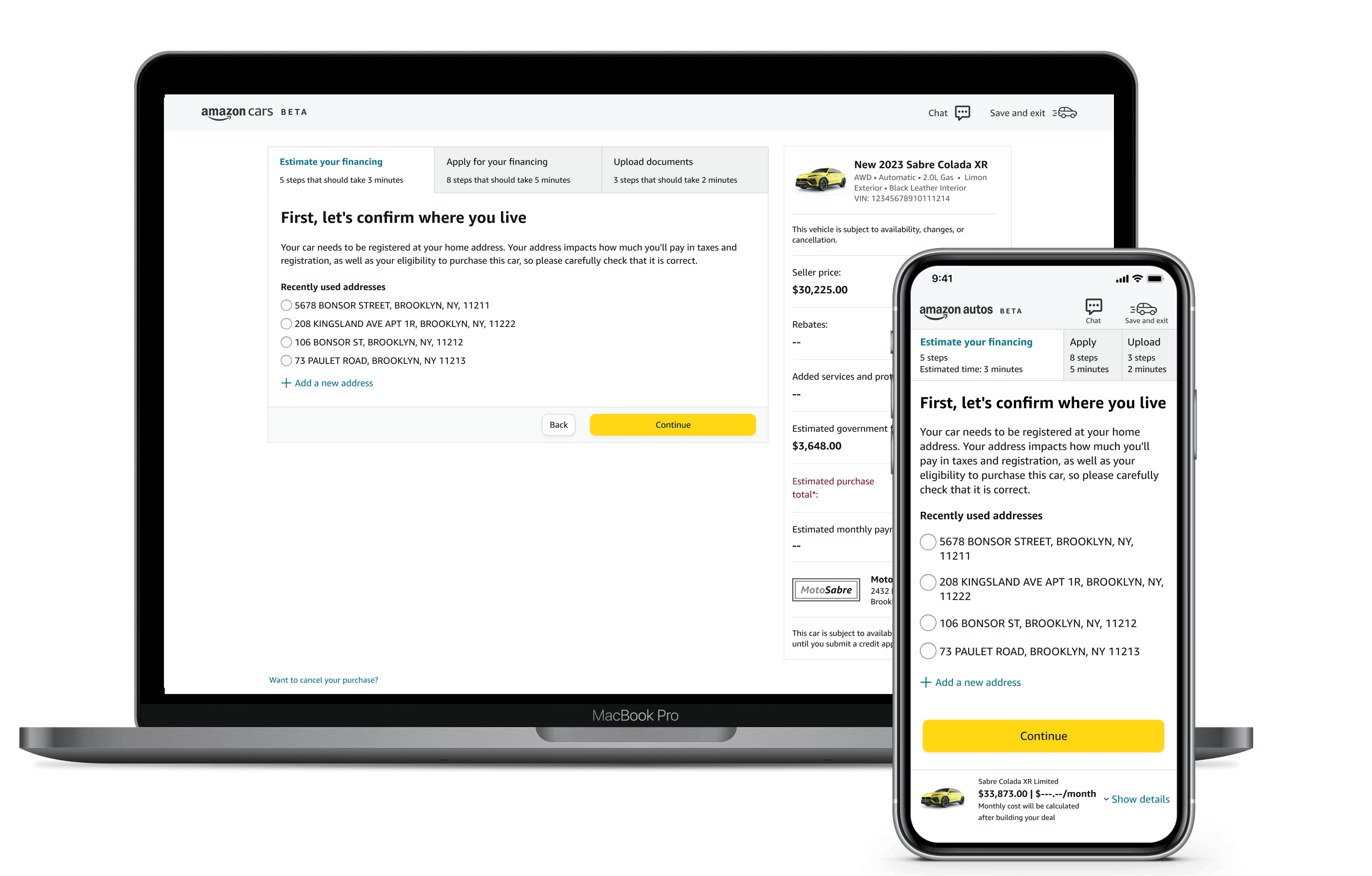
Sample of screens designed for the internal beta.
Delivering, launching, and improving the internal beta
Following ideation, user research, and stakeholder alignment, we transitioned into the detailed design phase to prepare for delivery. This phase involved crafting a comprehensive end-to-end experience, ensuring all edge cases were addressed. Additionally, we developed detailed specifications for accessibility, with a particular focus on custom components.
A sample from the accessibility annotations document, which outlines focus order considerations, is shown below:

A sample from the accessibility annotations document.
After implementing our MLP for the internal beta, I conducted User Acceptance Testing (UAT) across the entire experience, with a focus on accessibility. During this process, I identified and raised over 110 accessibility defects. I collaborated closely with Quality Assurance Engineers (QAEs) and Software Development Engineers (SDEs) to address these issues, working towards a 95% resolution rate before our public launch.
As well as UAT, I worked with a Senior Researcher to collect quantitative and qualitative feedback from beta participants to validate the end-to-end customer experience and identify gaps. To better understand the customer experience and probe survey responses, live interviews were conducted with beta customers after their purchase. Key highlights from our qualitive research:
After implementing our MLP for the internal beta, I conducted User Acceptance Testing (UAT) across the entire experience, with a focus on accessibility. During this process, I identified and raised over 110 accessibility defects. I collaborated closely with Quality Assurance Engineers (QAEs) and Software Development Engineers (SDEs) to address these issues, working towards a 95% resolution rate before our public launch.
As well as UAT, I worked with a Senior Researcher to collect quantitative and qualitative feedback from beta participants to validate the end-to-end customer experience and identify gaps. To better understand the customer experience and probe survey responses, live interviews were conducted with beta customers after their purchase. Key highlights from our qualitive research:
Convenience and simplicity
Convenience and simplicity
Transparency and fairness
Transparency and fairness
Time savings
Time savings
Confidence and support
Confidence and support
Key themes uncovered in the internal beta
We also tracked key metrics through our internal analytics tools to gather data on the performance of the beta. Here are some key highlights from our quantitative research on the internal beta:
12-minute time to complete checkout: Our process was significantly faster compared to competitors, such as Carvana, which takes approximately 25 minutes.
40% of abandonments were due to the lack of a trade-in option, making it the most common reason for drop-off.
With this in mind, the next step was to explore how we could address this significant drop-off—specifically by introducing a trade-in flow within the checkout process as a key conversion driver.
We also tracked key metrics through our internal analytics tools to gather data on the performance of the beta. Here are some key highlights from our quantitative research on the internal beta:
12-minute time to complete checkout (excluding contract signing): Our process was significantly faster compared to competitors, such as Carvana, which takes approximately 25 minutes.
40% of abandonments were due to the lack of a trade-in option, making it the most common reason for drop-off.
With this in mind, the next step was to explore how we could address this significant drop-off—specifically by introducing a trade-in flow within the checkout process as a key conversion driver.
Adding trade-ins to the experience
Among the many areas for improvement between the internal and public launch, I focused on designing a comprehensive end-to-end valuation and trade-in experience. This experience was integrated into the checkout process to facilitate trades and enable customers to complete their purchase seamlessly.
We began with research to identify key customer needs in this space, ensuring our solution addressed their expectations and pain points. I then developed a clickable prototype in Figma to bring the concept to life.
A sample from the experience tested is shown below.
→
→
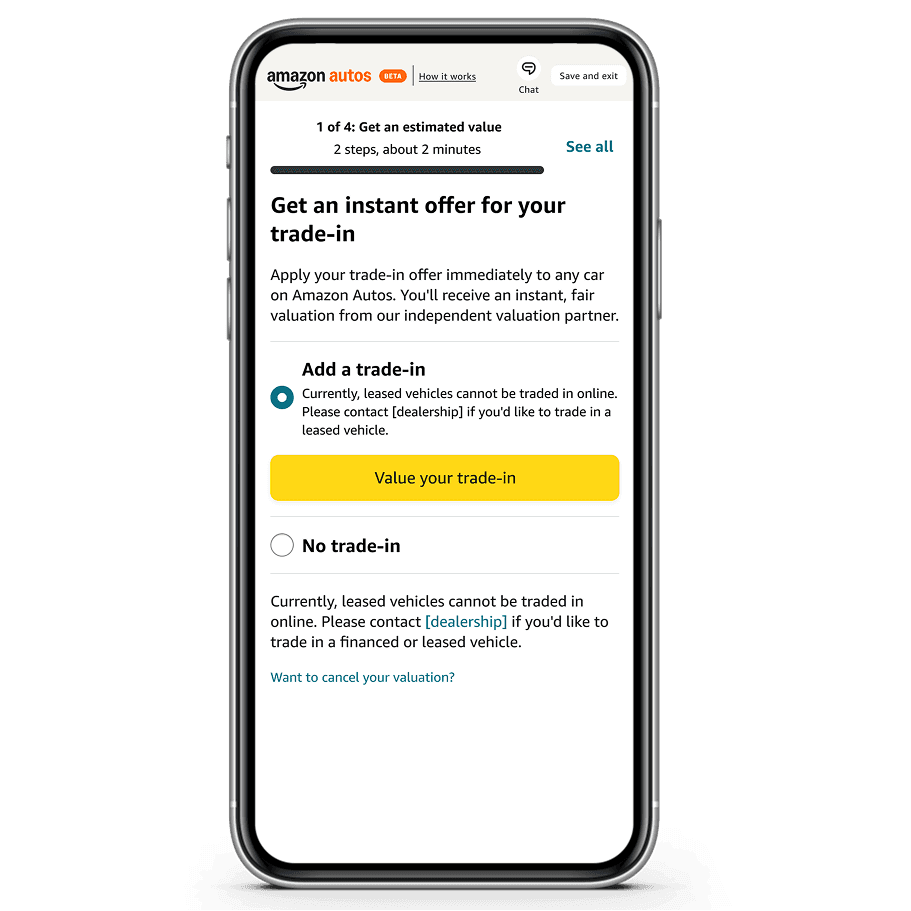
Sample of trade-in screens.
The biggest finding our first round of research revealed was that customers wanted to receive their trade-in valuation earlier in the experience to better understand their budget for a new car. This insight led us to reposition the trade-in feature from a conversion driver to an engagement driver.
As a result, I worked on designing a standalone trade-in experience, allowing customers to explore their options outside of the checkout process. Additionally, I explored various ways to drive engagement earlier in the upper funnel, ensuring that customers were better informed and more confident in their purchasing journey.
This involved enhancing the proposed experience by enabling customers to start a trade-in valuation outside of checkout. I designed a standalone flow with a dedicated landing page for education, along with banners serving as ingress points in the upper funnel.


9:41
9:41


The trade-in landing page enables customers to start a valuation outside of checkout.
The trade-in landing page enables customers to start a valuation outside of checkout.
I also designed both mobile and desktop banners, which would be used to drive traffic to the standalone trade-in experience. Concepts were worked on are currently being A/B tested for performance.
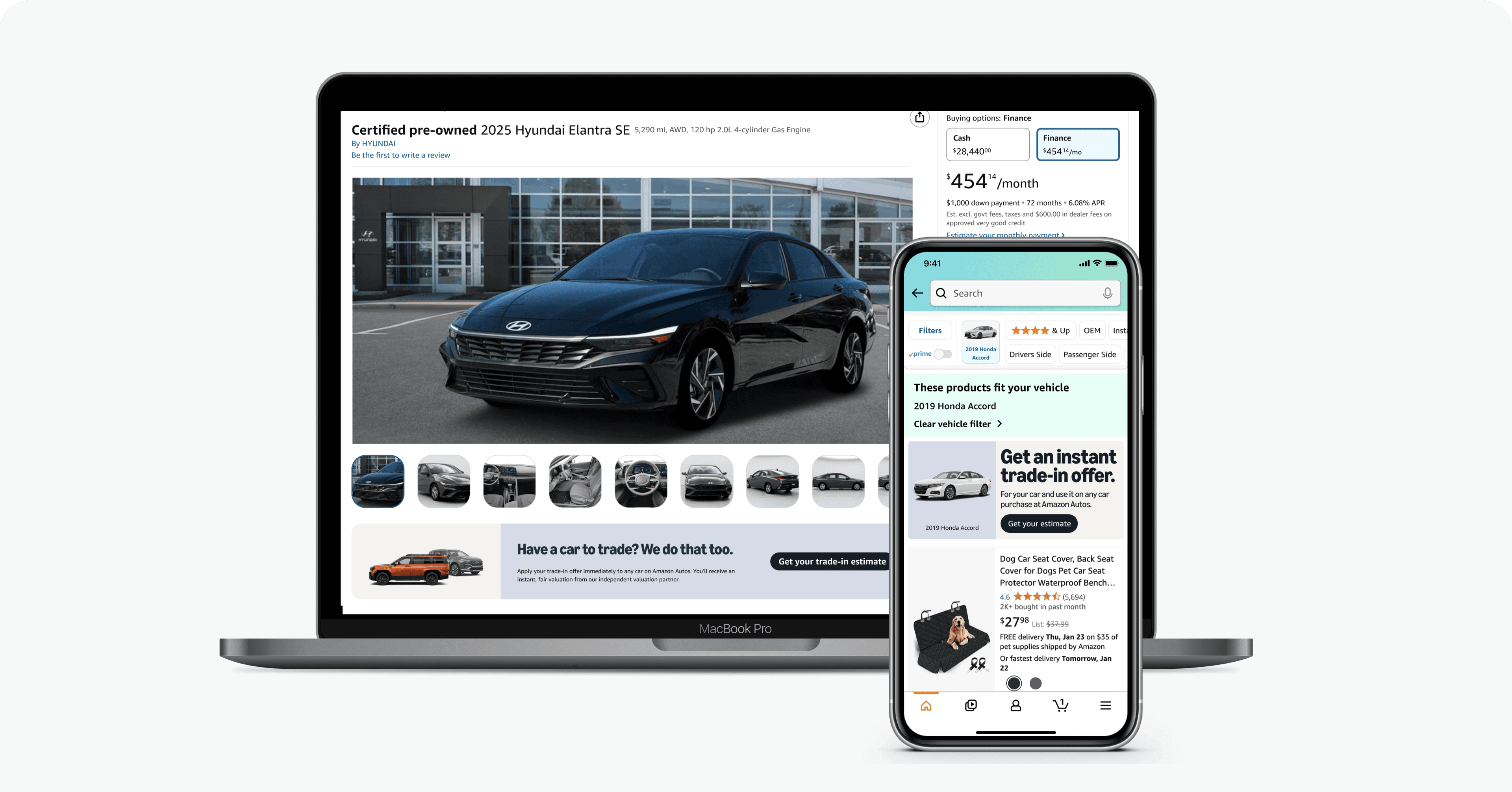
Banners designed to drive traffic to the trade-in valuation flow.
We conducted a second round of research on this experience to confirm that we addressed concerns around engagement in the upper funnel, as well as other key customer concerns, including trust in the valuation process, lack of clarity around drop-off procedures, and discomfort with sharing financial information for a valuation. These concerns were addressed, giving the team confidence in moving the feature toward public launch.
Public launch
After over two years of work, our December 2024 public launch was fast approaching. Hyundai contracted an agency for the mass marketing materials, and I provided input on the UI elements to be included, which can be seen in the following TV commercial.
Hyundai x Amazon – Hyundai’s TV commercial promoting the launch of Amazon Autos.
Hyundai x Amazon – Hyundai’s TV commercial promoting the launch of Amazon Autos.
Customer feedback and impact
Following our public launch, we’ve received overwhelmingly positive feedback, with highlights listed below:
I completed the entire car purchase in just 15 minutes, all from my phone while at the gym! The process was quick, easy, and straightforward, with everything handled smoothly. I loved the simplicity and speed of the experience, I was able to handle everything, from payment options and interest rates to warranties in no time at all and without any dealer pressure!
Hassle free and totally transparent. I despise car shopping because the traditional car sales still relies on annoying tactics of not providing the best price up front, constant back and forth, low balling trade ins, bait and switch tactics and the list goes on. Amazon made the experience 100% hassle free, transparent, and pretty much stress free. All car buying should be like this.
Following our public launch, we’ve received overwhelmingly positive feedback, with highlights listed below:
I completed the entire car purchase in just 15 minutes, all from my phone while at the gym! The process was quick, easy, and straightforward, with everything handled smoothly. I loved the simplicity and speed of the experience, I was able to handle everything, from payment options and interest rates to warranties in no time at all and without any dealer pressure!
Hassle free and totally transparent. I despise car shopping because the traditional car sales still relies on annoying tactics of not providing the best price up front, constant back and forth, low balling trade ins, bait and switch tactics and the list goes on. Amazon made the experience 100% hassle free, transparent, and pretty much stress free. All car buying should be like this.
A customer’s review of the process as she arrives at the dealership to pick up her new car.
As well as positive customer feedback, we’re seeing promising metrics in the early stages following the launch, including:
Surpassed first-month sales goal by 100%, achieving 200% of target: sales targets for the first month have been exceeded by over 100%, highlighting strong customer interest and demand. This performance suggests a successful initial adoption and indicates positive market reception.
Net promoter score (NPS) is 34% above target at 79.8: the NPS is currently 34% above the target, with a score of 79.8. An NPS above 50 is generally considered excellent, and this score indicates a very high level of customer satisfaction and loyalty
As well as positive customer feedback, we’re seeing promising metrics in the early stages following the launch, including:
Surpassed first-month sales goal by 100%, achieving 200% of target: sales targets for the first month have been exceeded by over 100%, highlighting strong customer interest and demand. This performance suggests a successful initial adoption and indicates positive market reception.
Net promoter score (NPS) is 34% above target at 79.8: the NPS is currently 34% above the target, with a score of 79.8. An NPS above 50 is generally considered excellent, and this score indicates a very high level of customer satisfaction and loyalty
External links
Ismael Bashagha – 2025 – Designing trusted, scalable products for millions of users.
Ismael Bashagha – 2025 – Designing trusted, scalable products for millions of users.
Designing and launching MLP
Discovery – generative research
I joined this project from its inception, relocating from London to New York to support its execution within Amazon Advertising. To kick things off, I worked closely with a Senior Researcher to conduct generative studies aimed at better understanding our target customers, evaluating their current car buying experience, identifying opportunities for improvement, and recognizing what was working well.
Through our research, we uncovered the following key themes and needs:
Lack of pricing clarity and trust
Overwhelming and fragmented processes
Uncertainty around trade-in value
Lack of control and convenience
Key themes uncovered in early research.
In addition to uncovering these user challenges, we translated them into “How Might We” statements to guide ideation and solution development within the team.
To further align our solutions with customer needs, we developed three key personas—New-to-the-Scene, Up-and-Comers, and Established. These personas were shared with the team to provide insights into customer goals, behaviors, and pain points, helping us tailor our approach and prioritize features effectively.
These insights provided a clear understanding of the key pain points and opportunities within the car buying journey, fostering broad alignment across the team. With this shared understanding, we transitioned into the ideation phase to explore and develop solutions that directly address customer needs.
Established
Up-and-Comers
New-to-the-scene
Three personas representing Amazon Autos customers.
Ideation
The first stage of the project focused on building a Minimal Lovable Product (MLP), launched as an internal beta to prove the feasibility of selling cars online. This involved integrating disparate dealer, Original Equipment Manufacturer (OEM), and financial systems into a cohesive, Amazon-hosted customer experience. My primary focus, with the support of a junior designer, during this phase was on the lower-funnel journey, specifically saved cars (cart), checkout, and post-purchase.
I designed an end-to-end checkout experience, leveraging insights from my previous work on the _Amazon Barclaycard project_ and broader desk research. Findings indicated that a one-thing-per-page format yields higher conversion rates, fewer errors, and improved accessibility. So this approach was also taken for checkout with the aim oi simplifying the customer journey and enhancing overall usability.
To validate the experience, I conducted user research with customers and traveled to Los Angeles to facilitate workshops with both the OEM and our Digital Retailing Solution (DRS) partner—key stakeholders in facilitating online vehicle purchasing. The purpose of these exercises was to evaluate the existing experience from both a user need and technical / business feasibility perspective.
During the evaluative workshops, I provided an on-screen walkthrough of the experience, highlighting key touchpoints and functionality. In addition, I printed each screen for an interactive session where stakeholders used post-it notes to identify areas for improvement, feasibility considerations, and necessary changes. This collaborative process helped align cross-functional teams and refine the experience based on real-world constraints and opportunities.
Stakeholders collaborate using post-it notes to identify improvements, feasibility considerations, and necessary changes in this evaluative workshop.
To assess the customer experience, I created a clickable prototype in Figma and conducted a moderated usability study. I collaborated with a junior designer to assist with note-taking and synthesis. The study focused on the end-to-end checkout experience on desktop, covering the journey from Saved Cars to the Thank You page.
The following video provides a walkthrough of the prototype tested, showcasing the first iteration of the lower funnel experience I designed.


A walkthrough of the clickable prototype tested.
The research was vital in identifying strengths in the experience and areas for improvement. A sample of findings are summarized below:
Purchase status ambiguity
Pain points
Data handling concerns
Key themes uncovered in early research.
Familiar and seamless experience
Strengths
Financial transparency
Core functionality
Findings from this research, along with insights from OEM and DRS workshops, informed improvements to the experience, ensuring customer needs were met while aligning with business and technical requirements. Similar processes were conducted by myself and a supporting junior designer for the post-purchase experiences.
A sample of the screens designed for the internal beta is shown below, from a time when the product was still referred to as Amazon Cars.
→
→
Sample of screens designed for the internal beta.
Delivering, launching, and improving the internal beta
Following ideation, user research, and stakeholder alignment, we transitioned into the detailed design phase to prepare for delivery. This phase involved crafting a comprehensive end-to-end experience, ensuring all edge cases were addressed. Additionally, we developed detailed specifications for accessibility, with a particular focus on custom components.
A sample from the accessibility annotations document, which outlines focus order considerations, is shown below:
A sample from the accessibility annotations document.
After implementing our MLP for the internal beta, I conducted User Acceptance Testing (UAT) across the entire experience, with a focus on accessibility. During this process, I identified and raised over 110 accessibility defects. I collaborated closely with Quality Assurance Engineers (QAEs) and Software Development Engineers (SDEs) to address these issues, working towards a 95% resolution rate before our public launch.
As well as UAT, I worked with a Senior Researcher to collect quantitative and qualitative feedback from beta participants to validate the end-to-end customer experience and identify gaps. To better understand the customer experience and probe survey responses, live interviews were conducted with beta customers after their purchase. Key highlights from our qualitive research:
Convenience and simplicity
Transparency and fairness
Time savings
Confidence and support
Key themes uncovered in the internal beta
We also tracked key metrics through our internal analytics tools to gather data on the performance of the beta. Here are some key highlights from our quantitative research on the internal beta:
12-minute time to complete checkout (excluding contract signing): Our process was significantly faster compared to competitors, such as Carvana, which takes approximately 25 minutes.
40% of abandonments were due to the lack of a trade-in option, making it the most common reason for drop-off.
With this in mind, the next step was to explore how we could address this significant drop-off—specifically by introducing a trade-in flow within the checkout process as a key conversion driver.
Adding trade-ins to the experience
Among the many areas for improvement between the internal and public launch, I focused on designing a comprehensive end-to-end valuation and trade-in experience. This experience was integrated into the checkout process to facilitate trades and enable customers to complete their purchase seamlessly.
We began with research to identify key customer needs in this space, ensuring our solution addressed their expectations and pain points. I then developed a clickable prototype in Figma to bring the concept to life.
A sample from the experience tested is shown below.


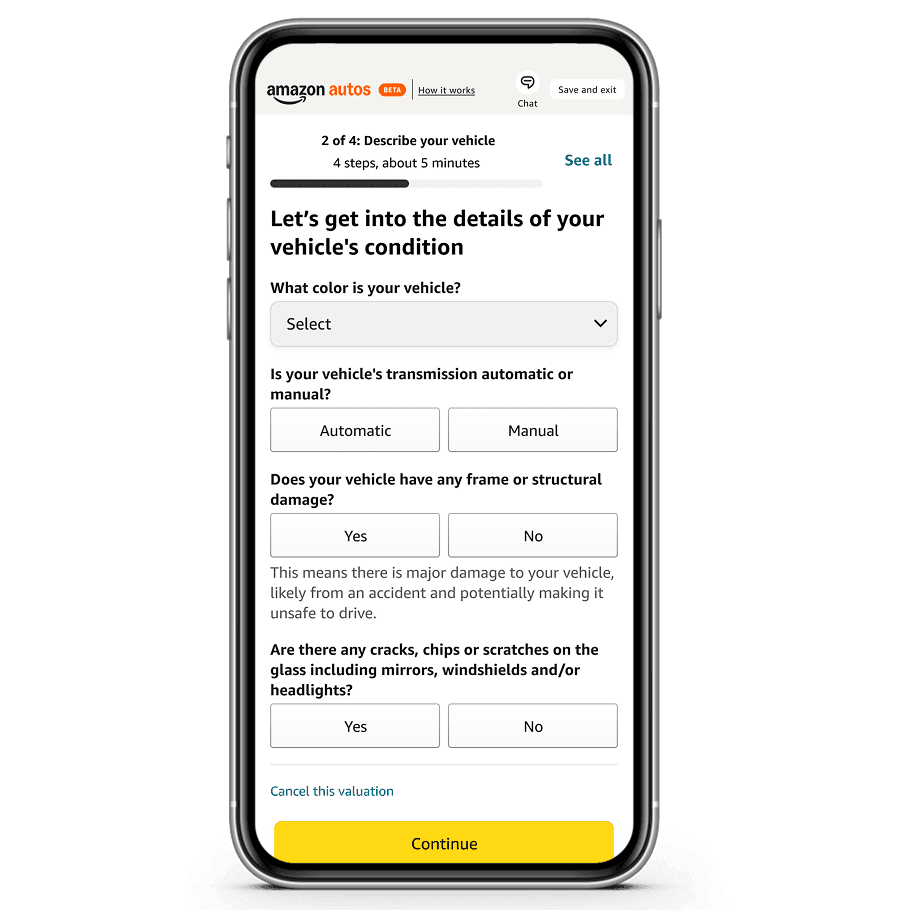
Sample of trade-in screens.
The biggest finding our first round of research revealed was that customers wanted to receive their trade-in valuation earlier in the experience to better understand their budget for a new car. This insight led us to reposition the trade-in feature from a conversion driver to an engagement driver.
As a result, I worked on designing a standalone trade-in experience, allowing customers to explore their options outside of the checkout process. Additionally, I explored various ways to drive engagement earlier in the upper funnel, ensuring that customers were better informed and more confident in their purchasing journey.
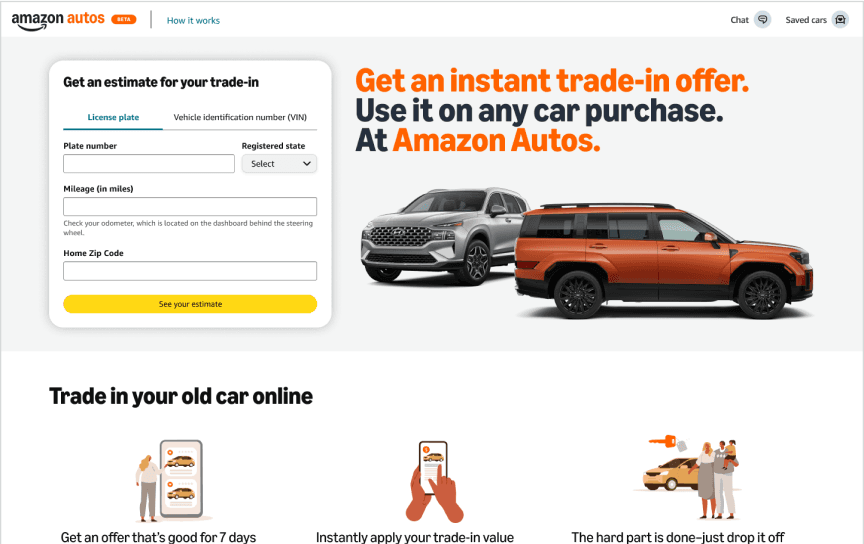
This involved enhancing the proposed experience by enabling customers to start a trade-in valuation outside of checkout. I designed a standalone flow with a dedicated landing page for education, along with banners serving as ingress points in the upper funnel.
9:41


The trade-in landing page enables customers to start a valuation outside of checkout.
I also designed both mobile and desktop banners, which would be used to drive traffic to the standalone trade-in experience. Concepts were worked on are currently being A/B tested for performance.

The trade-in landing page enables customers to start a valuation outside of checkout.
We conducted a second round of research on this experience to confirm that we addressed concerns around engagement in the upper funnel, as well as other key customer concerns, including trust in the valuation process, lack of clarity around drop-off procedures, and discomfort with sharing financial information for a valuation. These concerns were addressed, giving the team confidence in moving the feature toward public launch.
Public launch
After over two years of work, our December 2024 public launch was fast approaching. Hyundai contracted an agency for the mass marketing materials, and I provided input on the UI elements to be included, which can be seen in the following TV commercial.


Hyundai x Amazon – Hyundai’s TV commercial promoting the launch of Amazon Autos.
Below is a voiceover and a recorded video walkthrough of the live experience.The recording is from Figma for data privacy purposes. However, feel free to visit Amazon to view and purchase a Hyundai online!

Voiceover and a recorded video walkthrough of the live Amazon Autos experience.
Customer feedback and impact
Following our public launch, we’ve received overwhelmingly positive feedback, with highlights listed below:
I completed the entire car purchase in just 15 minutes, all from my phone while at the gym! The process was quick, easy, and straightforward, with everything handled smoothly. I loved the simplicity and speed of the experience, I was able to handle everything, from payment options and interest rates to warranties in no time at all and without any dealer pressure!
Hassle free and totally transparent. I despise car shopping because the traditional car sales still relies on annoying tactics of not providing the best price up front, constant back and forth, low balling trade ins, bait and switch tactics and the list goes on. Amazon made the experience 100% hassle free, transparent, and pretty much stress free. All car buying should be like this.

A customer’s review of the process as she arrives at the dealership to pick up her new car.
As well as positive customer feedback, we’re seeing promising metrics in the early stages following the launch, including:
Surpassed first-month sales goal by 100%, achieving 200% of target: sales targets for the first month have been exceeded by over 100%, highlighting strong customer interest and demand. This performance suggests a successful initial adoption and indicates positive market reception.
Net promoter score (NPS) is 34% above target at 79.8: the NPS is currently 34% above the target, with a score of 79.8. An NPS above 50 is generally considered excellent, and this score indicates a very high level of customer satisfaction and loyalty
Ismael Bashagha – 2025 – Designing trusted, scalable products for millions of users.