Extracts from the research report studying different credit card application forms.
NHS TEST & TRACE
NHS TEST & TRACE
Designing a scalable digital solution to transform COVID-19 testing and streamline workflows across the UK.
Designing a scalable digital solution to transform COVID-19 testing and streamline workflows across the UK.
Designing at unprecedented scale
This project encompassed the end-to-end design of all iOS apps developed to support COVID-19 testing at scale. As the Lead Product Designer, I was responsible for the entire design process, from initial research and wireframing to final implementation. The goal was to create a seamless digital experience that simplified check-ins, improved accessibility, and provided real-time updates to users. By leveraging user research, we identified key pain points and iterated rapidly to enhance the experience, ensuring the app could handle surges in demand while maintaining accuracy and usability. Here is a short video outlining the work we did.
Transforming COVID-19 testing in the UK: how we designed digital solutions to scale testing, cut check-in times, and speed up results, helping millions during the pandemic.
Dispatch: rethinking COVID-19 test tracking for efficiency and scale
Of the suite of 10 apps developed for the program, this case study will focus on Dispatch. Dispatch was designed to streamline the tracking of test kits from test sites to labs, ensuring accountability and enabling labs to anticipate incoming test volumes. It played a key role in addressing existing challenges and supported the government in achieving its ambitious testing targets.
Discovery
I led the discovery phase to define key problem areas and user needs related to test kit tracking and workflow efficiency. The primary goal was to address limited visibility into the tracking process and better understand how operatives packed and dispatched test kits on-site—challenges that directly impacted nationwide testing capacity and accountability.
Working alongside a junior researcher, I conducted remote interviews with site operatives via Zoom to uncover pain points in their daily processes. We synthesised findings in Miro, mapping workflows and identifying systemic inefficiencies that demanded a scalable, adaptable solution.
From this, we distilled the challenge into three core operational processes:
→
→
→
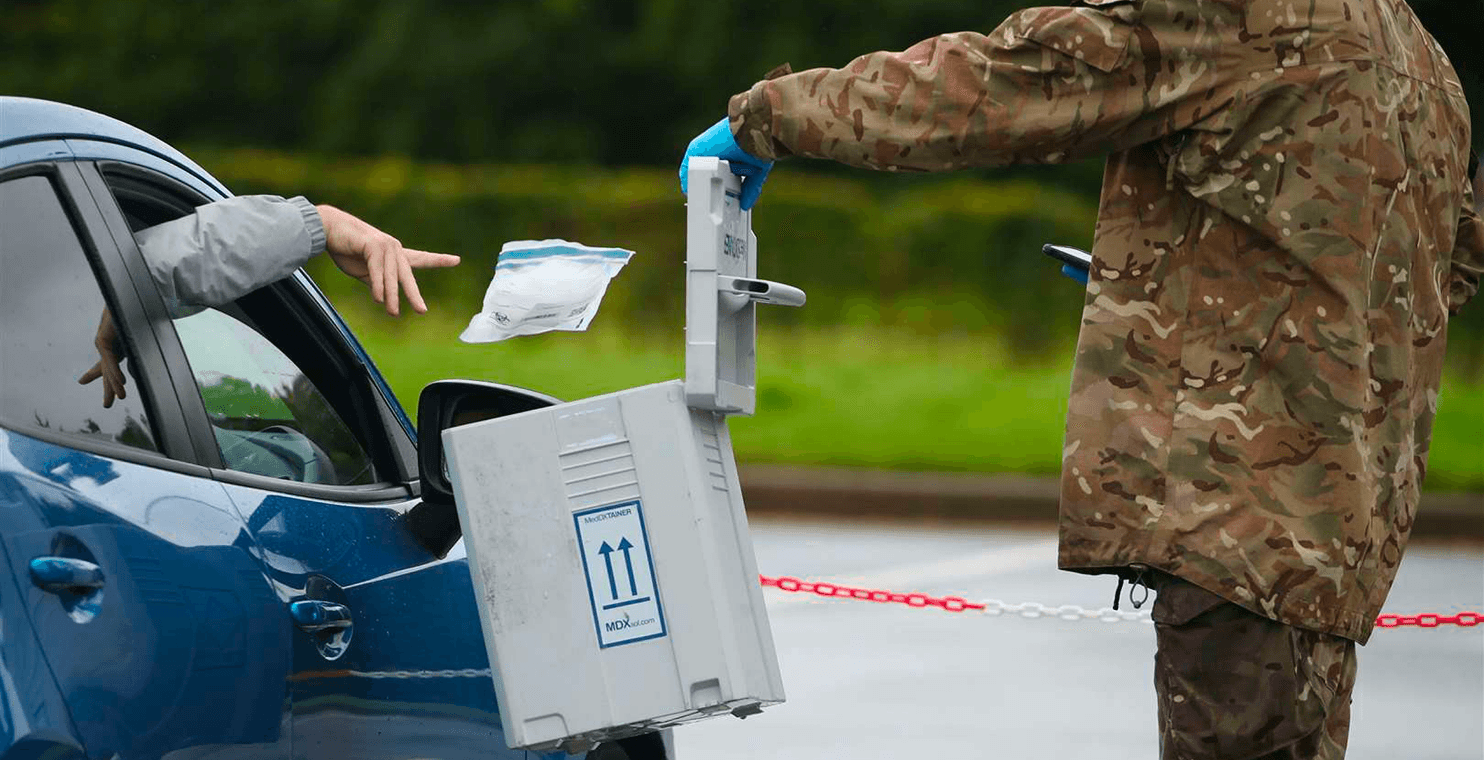
Direct test kit drop-offs into courier boxes. At certain test sites, individuals placed their test kits directly into pre-labeled courier boxes after completing their tests. This streamlined the packing process but required additional tracking.
This research identified the inconsistent workflows across test sites, highlighting the need for a flexible solution that could accommodate multiple scenarios.
Ideation, prototyping and testing
The ideation phase began with virtual brainstorming workshops and collaborative sessions to explore potential solutions based on research insights. Using Miro, we mapped out user journeys and prioritized features based on the most pressing user needs. I facilitated sketching sessions with product managers and engineers to rapidly iterate on realistic solutions.
Key objectives for the ideation process included:
Designing a seamless process for associating test kits with courier boxes.
Providing a clear and intuitive way for site operatives to mark boxes as dispatched and allow labs to understand the number of tests to expect.
Incorporating the disparate and inconsistent site operation workflows into a universal solution.
To accommodate sites where test kits were dropped directly into courier boxes, additional functionality was integrated into a separate app, Check-in, enabling test kits to be linked to boxes at the time of check-in.
The prototyping and testing phase began with internal sketches to align the team on the app's design direction and core workflows. These sketches served as a foundation for the first interactive prototypes, developed using Sketch and InVision.

Basic sketches: Initial hand-drawn sketches capturing the core ideas and user flows for the Dispatch app.
To validate our early concepts, I created a high-fidelity prototype based on initial sketches and conducted remote usability testing with site operatives. These clickable prototypes simulated key user journeys, allowing us to observe real-time interactions and gather feedback on clarity, ease of use, and overall task flow.

First prototype: High-fidelity prototype, based on initial sketches, for user testing.
Testing revealed a need for stronger visual guidance and clearer feedback during scanning tasks. In response, I redesigned the interface to include a split-screen scanner view with step-by-step instructions and introduced real-time feedback upon scan completion. I also added a subtle animation to confirm task success — a small but effective touch that was later rolled out across all related apps in the suite.

Improving visual cues: a split-screen scanner view with clear instructions on how to scan test kits, and real-time feedback after scanning.
I collaborated closely with developers to quickly build a functioning prototype for live, on-site testing. During a pilot phase at a Newcastle test site, observing the tool in real-world conditions revealed critical areas for refinement. These included:
Adjusting scanner sensitivity to prevent over-scanning and ensure only the intended barcodes were captured — crucial for accuracy in fast-paced, cluttered environments.
Improving the confirmation screen by adding contextual details, such as whether test kits had been marked as packed or dispatched.
These real-time insights enabled us to make rapid, targeted improvements, ensuring the app was both robust and intuitive ahead of its nationwide rollout.
I collaborated closely with developers to quickly build a functioning prototype for live, on-site testing. During a pilot phase at a Newcastle test site, observing the tool in real-world conditions revealed critical areas for refinement. These included:
Adjusting scanner sensitivity to prevent over-scanning and ensure only the intended barcodes were captured — crucial for accuracy in fast-paced, cluttered environments.
Improving the confirmation screen by adding contextual details, such as whether test kits had been marked as packed or dispatched.
These real-time insights enabled us to make rapid, targeted improvements, ensuring the app was both robust and intuitive ahead of its nationwide rollout.
On-site usability testing: Footage of the apps in use during the pilot phase revealed key insights, such as the need for improved scanner hints and enhanced feedback to confirm task completion—a proud moment seeing the design come to life in real-world conditions.
Delivery and impact
I collaborated closely with iOS developers to refine and build the app, ensuring it met the needs of diverse user groups. After successful pilot testing in Newcastle, I supported the nationwide rollout by producing user guides and conducting training sessions for regional leads. This ensured consistency and efficiency in the app’s adoption across thousands of test sites.
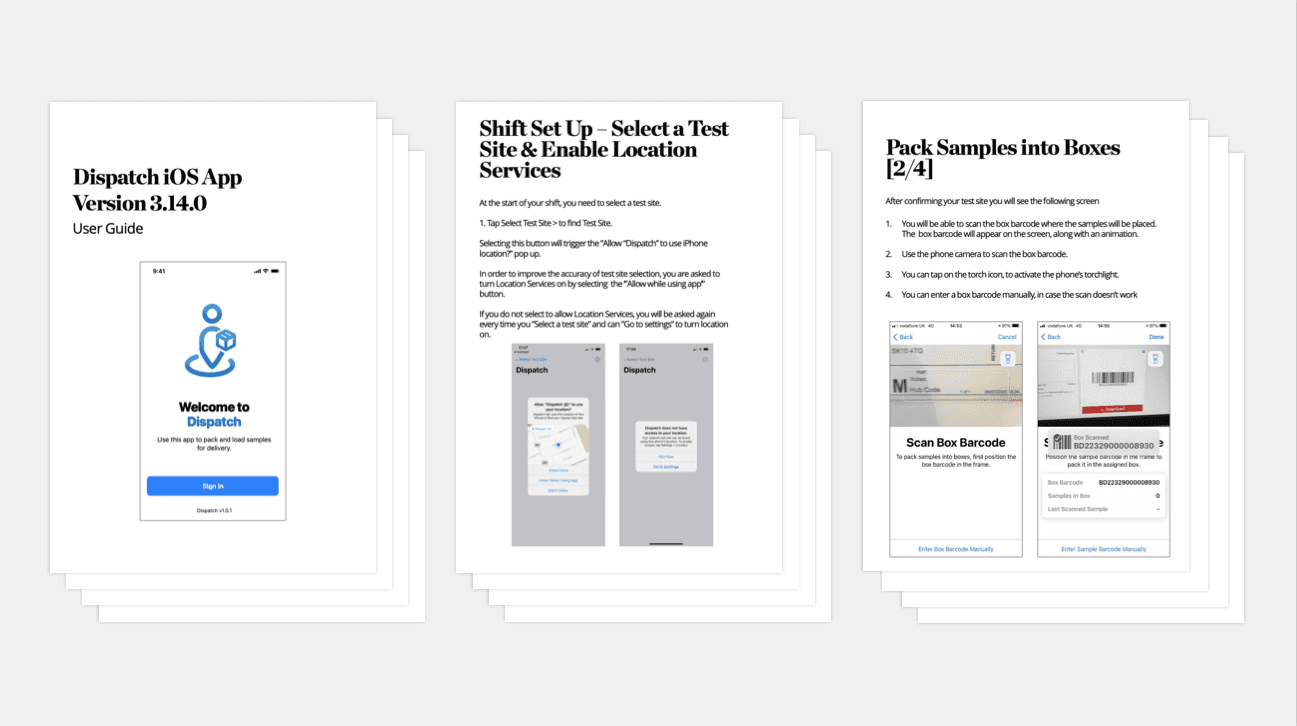
Supporting the rollout: User guides I created to support the app's deployment across thousands of test sites in the UK, accompanied by training for regional leads to ensure seamless adoption.
The Dispatch app became a cornerstone of the UK’s COVID-19 testing program, enabling better tracking and management of test kits. Together with the suite of apps, it reduced processing times, minimized errors, and helped meet ambitious testing targets. Key metrics include:
Increasing testing capacity from 5,000 to over 45,000 tests per day initially, later exceeding 500,000.
Improving next-day result rates from 14% to 74% within one month.
Processing over 160 million tests by June 2021.
By improving scalability and accountability, the program achieved a transformative impact on the nation’s pandemic response.
Ismael Bashagha – 2025 – Designing trusted, scalable products for millions of users.
Ismael Bashagha – 2025 – Designing trusted, scalable products for millions of users.
Brief
Amid the unprecedented COVID-19 crisis, Deloitte Digital was asked by the NHS to rapidly launch a robust national testing program to stem the spread of the virus. The solution had to increase national testing capacity by eliminating paper-based workflows, reducing human error, and supporting the launch of up to 45 new test sites per week.
Outcome
We launched a suite of iOS apps, deployed on 12,000 centrally managed iPhones. These apps streamlined check-ins, sample tracking, and lab prioritization, enabling a ninefold increase in testing capacity from 5,000 to over 45,000 tests per day initially (later exceeding 500,000). The program also improved next-day result rates from 14% to 74% in just one month. By June 2021, over 160 million tests had been processed, significantly impacting the U.K.'s pandemic response. This work was awarded a BIMA10 Award for its role in rapidly transforming critical public health infrastructure through intuitive, scalable digital design.
My Role
As Lead Product Designer, I was responsible for the design of all 10 apps, ensuring they were intuitive, accessible, and scalable. I managed two product designers and worked closely with cross-functional teams—including engineers and lab staff—to understand workflows and optimise usability. With support from a researcher, I conducted usability studies at test facilities and iterated the designs to meet the programme’s strict accuracy and speed requirements under tight deadlines.
Toolkit
Design: Sketch · Flinto · InVision · Abstract
Research: SurveyMonkey · UserTesting · Miro
Awards
Designing at unprecedented scale
This project encompassed the end-to-end design of all iOS apps developed to support COVID-19 testing at scale. As the Lead Product Designer, I was responsible for the entire design process, from initial research and wireframing to final implementation. The goal was to create a seamless digital experience that simplified check-ins, improved accessibility, and provided real-time updates to users. By leveraging user research, we identified key pain points and iterated rapidly to enhance the experience, ensuring the app could handle surges in demand while maintaining accuracy and usability. Here is a short video outlining the work we did.

Transforming COVID-19 testing in the UK: how we designed digital solutions to scale testing, cut check-in times, and speed up results, helping millions during the pandemic.
Dispatch: rethinking COVID-19 test tracking for efficiency and scale
Of the suite of 10 apps developed for the program, this case study will focus on Dispatch. Dispatch was designed to streamline the tracking of test kits from test sites to labs, ensuring accountability and enabling labs to anticipate incoming test volumes. It played a key role in addressing existing challenges and supported the government in achieving its ambitious testing targets.
Discovery
I led the discovery phase to define key problem areas and user needs related to test kit tracking and workflow efficiency. The primary goal was to address limited visibility into the tracking process and better understand how operatives packed and dispatched test kits on-site—challenges that directly impacted nationwide testing capacity and accountability.
Working alongside a junior researcher, I conducted remote interviews with site operatives via Zoom to uncover pain points in their daily processes. We synthesised findings in Miro, mapping workflows and identifying systemic inefficiencies that demanded a scalable, adaptable solution.
From this, we distilled the challenge into three core operational processes:


Direct test kit drop-offs into courier boxes. At certain test sites, individuals placed their test kits directly into pre-labeled courier boxes after completing their tests. This streamlined the packing process but required additional tracking to ensure every test kit was accounted for.
This research identified the inconsistent workflows across test sites, highlighting the need for a flexible solution that could accommodate multiple scenarios.
Ideation, prototyping and testing
The ideation phase began with virtual brainstorming workshops and collaborative sessions to explore potential solutions based on research insights. Using Miro, we mapped out user journeys and prioritized features based on the most pressing user needs. I facilitated sketching sessions with product managers and engineers to rapidly iterate on realistic solutions.
Key objectives for the ideation process included:
Designing a seamless process for associating test kits with courier boxes.
Providing a clear and intuitive way for site operatives to mark boxes as dispatched and allow labs to understand the number of tests to expect.
Incorporating the disparate and inconsistent site operation workflows into a universal solution.
To accommodate sites where test kits were dropped directly into courier boxes, additional functionality was integrated into a separate app, Check-in, enabling test kits to be linked to boxes at the time of check-in.
The prototyping and testing phase began with internal sketches to align the team on the app's design direction and core workflows. These sketches served as a foundation for the first interactive prototypes, developed using Sketch and InVision.

Basic sketches: Initial hand-drawn sketches capturing the core ideas and user flows for the Dispatch app.
To validate our early concepts, I created a high-fidelity prototype based on initial sketches and conducted remote usability testing with site operatives. These clickable prototypes simulated key user journeys, allowing us to observe real-time interactions and gather feedback on clarity, ease of use, and overall task flow.
First prototype: High-fidelity prototype, based on initial sketches, for user testing.
Testing revealed a need for stronger visual guidance and clearer feedback during scanning tasks. In response, I redesigned the interface to include a split-screen scanner view with step-by-step instructions and introduced real-time feedback upon scan completion. I also added a subtle animation to confirm task success — a small but effective touch that was later rolled out across all related apps in the suite.
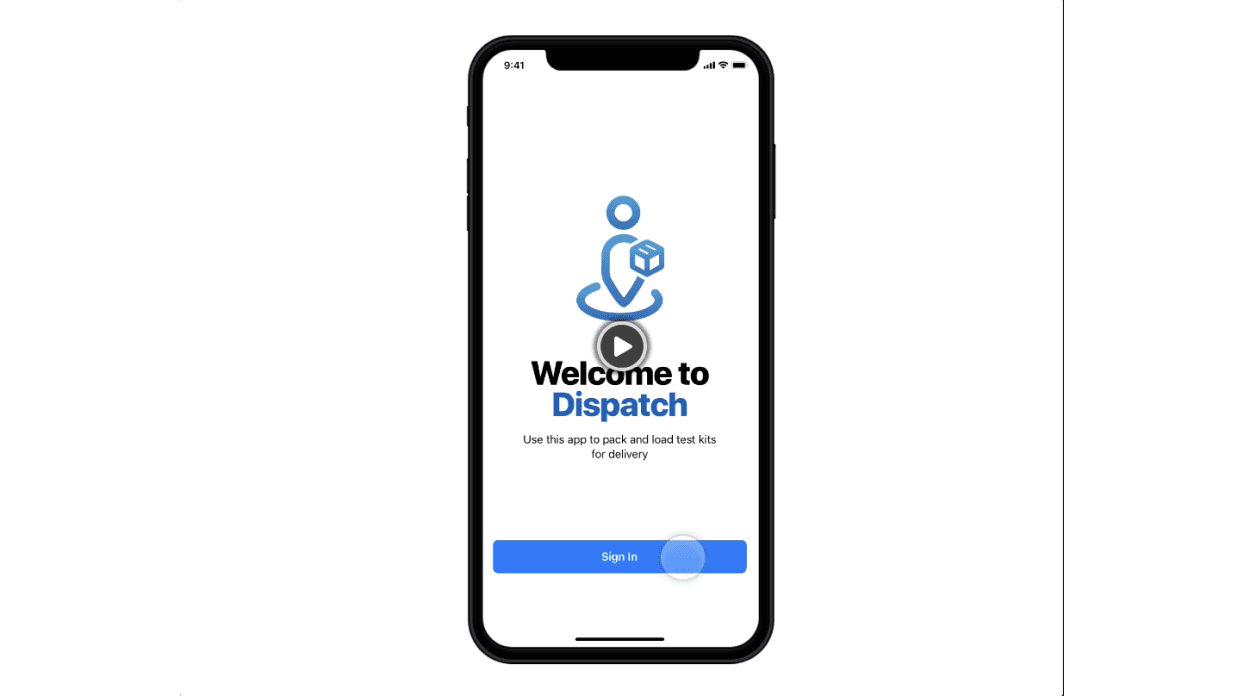
Improving visual cues: a split-screen scanner view with clear instructions on how to scan test kits, and real-time feedback after scanning.
I collaborated closely with developers to quickly build a functioning prototype for live, on-site testing. During a pilot phase at a Newcastle test site, observing the tool in real-world conditions revealed critical areas for refinement. These included:
Adjusting scanner sensitivity to prevent over-scanning and ensure only the intended barcodes were captured — crucial for accuracy in fast-paced, cluttered environments.
Improving the confirmation screen by adding contextual details, such as whether test kits had been marked as packed or dispatched.
These real-time insights enabled us to make rapid, targeted improvements, ensuring the app was both robust and intuitive ahead of its nationwide rollout.

On-site usability testing: Footage of the apps in use during the pilot phase revealed key insights, such as the need for improved scanner hints and enhanced feedback to confirm task completion—a proud moment seeing the design come to life in real-world conditions.
Delivery and impact
I collaborated closely with iOS developers to refine and build the app, ensuring it met the needs of diverse user groups. After successful pilot testing in Newcastle, I supported the nationwide rollout by producing user guides and conducting training sessions for regional leads. This ensured consistency and efficiency in the app’s adoption across thousands of test sites.
Supporting the rollout: User guides I created to support the app's deployment across thousands of test sites in the UK, accompanied by training for regional leads to ensure seamless adoption.
The Dispatch app became a cornerstone of the UK’s COVID-19 testing program, enabling better tracking and management of test kits. Together with the suite of apps, it reduced processing times, minimized errors, and helped meet ambitious testing targets. Key metrics include:
Increasing testing capacity from 5,000 to over 45,000 tests per day initially, later exceeding 500,000.
Improving next-day result rates from 14% to 74% within one month.
Processing over 160 million tests by June 2021.
By improving scalability and accountability, the program achieved a transformative impact on the nation’s pandemic response.
Ismael Bashagha – 2025 – Designing trusted, scalable products for millions of users.

NHS TEST & TRACE
Designing a scalable digital solution to transform COVID-19 testing and streamline workflows across the UK.
Brief
Amid the unprecedented COVID-19 crisis, Deloitte Digital was asked by the NHS to rapidly launch a robust national testing program to stem the spread of the virus. The solution had to increase national testing capacity by eliminating paper-based workflows, reducing human error, and supporting the launch of up to 45 new test sites per week.
Outcome
We launched a suite of iOS apps, deployed on 12,000 centrally managed iPhones. These apps streamlined check-ins, sample tracking, and lab prioritization, enabling a ninefold increase in testing capacity from 5,000 to over 45,000 tests per day initially (later exceeding 500,000). The program also improved next-day result rates from 14% to 74% in just one month. By June 2021, over 160 million tests had been processed, significantly impacting the U.K.'s pandemic response. This work was awarded a BIMA10 Award for its role in rapidly transforming critical public health infrastructure through intuitive, scalable digital design.
My Role
As Lead Product Designer, I was responsible for the design of all 10 apps, ensuring they were intuitive, accessible, and scalable. I managed two product designers and worked closely with cross-functional teams—including engineers and lab staff—to understand workflows and optimise usability. With support from a researcher, I conducted usability studies at test facilities and iterated the designs to meet the programme’s strict accuracy and speed requirements under tight deadlines.
Toolkit
Design: Sketch · Flinto · InVision · Abstract
Research: SurveyMonkey · UserTesting · Miro
Awards
